# Sustainability
07.07.2026
Automotive compounds in 2030: The impact of the End-of-Life Vehicles Regulation (ELVR)
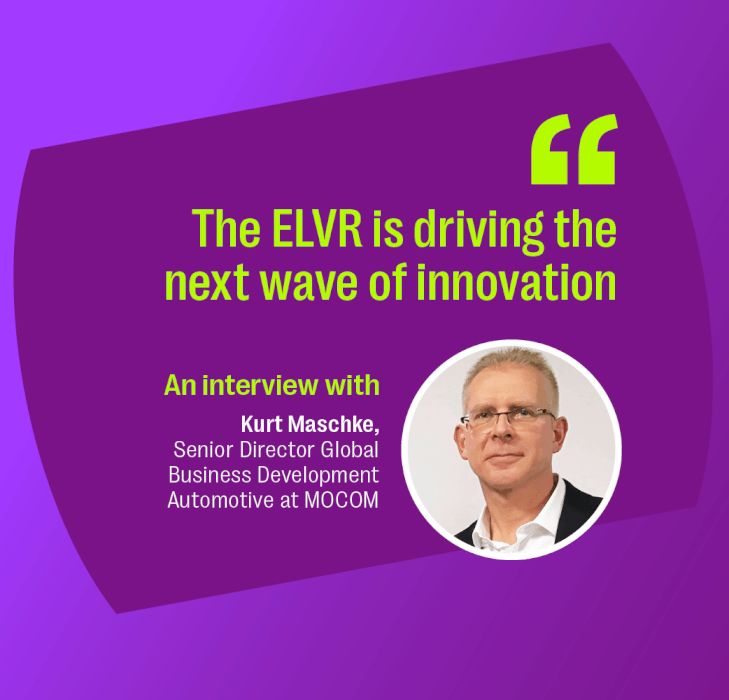
The new End-of-Life Vehicles Regulation (ELVR) is set to fundamentally reshape the automotive industry. Recycling targets, design for recycling and the increased use of recycled materials are becoming ever more important for vehicle manufacturers and their supply chains. But what does this mean in practice for plastic compounds and material development in the automotive sector?
In this interview, Kurt Maschke, responsible for Global Automotive Business Development at MOCOM, discusses the challenges and opportunities arising from the ELV Regulation.
What does the ELV Regulation mean for the industry?
Kurt Maschke (KM): Like many regulatory developments before it, the ELV Regulation is initially a challenge. At the same time, it offers tremendous potential for innovation. We have already seen with topics such as CO₂ reduction that regulatory pressure can accelerate innovation. The same is happening with the ELVR today. The requirements are known. The focus now is on implementing them jointly across the entire value chain.
Why does the ELV Regulation affect more than just vehicle manufacturers?
KM: While OEMs carry overall responsibility and are leading implementation efforts, success will only be possible through collaboration across the entire supply chain. Material decisions are never made in isolation. System suppliers, compounders, raw material producers and processors all need to work together to develop solutions. As a result, collaboration will need to begin much earlier than it has in the past. Companies that want to successfully address the ELVR should involve all relevant partners during the development phase.
What impact will the ELV Regulation have on material selection and component design?
KM: One of the most important topics is design for recycling. Components must be designed from the outset so they can later be efficiently disassembled and recycled. At the same time, material selection is becoming increasingly important. It's no longer only about mechanical performance. It's also about how effectively a material can be returned to the circular economy.
What role does recycled content play within the ELVR requirements?
KM: The ELV Regulation aims to strengthen the circular economy. That's why the primary focus is on post-consumer recycled (PCR) content. Mechanical recycling is currently preferred. Going forward, chemical recycling and bio-based feedstocks will also play an important role. Particularly in the case of polymers where a closed-loop approach is difficult to implement, or in applications with very high technical requirements, we will be reliant on chemical recycling in the long term to ensure the material properties required for further processing. At its core, however, the ELVR is about the closed-loop concept: plastics should be reused in comparable applications whenever possible.
Which applications are already suitable for high recycled content?
KM: Large components such as wheel arch liners, underbody shields and engine covers are already well suited for this. Interior applications are more challenging because they must also meet strict emissions and odor requirements. Technically, this is already possible and we have successfully completed projects in this area, but the necessary volumes are not yet available.
Safety-critical components are even more demanding. Recycled solutions will generally be possible, but implementation will take longer. Consider, for example, an airbag housing made from polyamide. Chemical recycling can achieve comparable quality. With mechanically recycled materials, compromises may be required. Although solutions are technically feasible, less critical applications will likely be addressed first.
What are currently the biggest challenges when using recyclates?
KM: The biggest challenge is often not technology but economics. Of course, mechanical performance requirements must also be considered. In addition, recycled materials may require adjustments to processing windows and manufacturing conditions.
Another important aspect is the recovery of end-of-life vehicles. Older plastics may contain substances that are no longer permitted today. These materials must be carefully evaluated before they can be returned to the recycling stream.
How can sustainability goals and technical requirements be achieved simultaneously?
KM: This requires contributions from all stakeholders. Material manufacturers and compounders must continue developing innovative solutions. Through targeted additive technologies and optimized formulations, many properties can already be brought to a very high level.
At the same time, we hear from vehicle manufacturers that they are willing to critically reassess specifications in order to enable higher recycled content. The right balance is essential, which is why joint development projects and close collaboration across the value chain are more important than ever.
How is the ELVR influencing the development of new compounds?
KM: For us, the future clearly belongs to compounds containing recycled content. With every new development, we evaluate how PCR (post-consumer recycled) content can be integrated. From today's perspective, materials containing around 20 to 30 percent of PCR content are expected to find their way into many areas of application. This range provides a strong balance between sustainability and technical performance.
Will recyclability become as important as mechanical properties in material selection?
KM: Absolutely. Recyclability will become an equally important selection criterion alongside mechanical performance. The industry is still at the beginning of this transition, but the direction is clear.
What sets MOCOM apart in this environment?
KM: We combine decades of automotive experience with extensive recycling expertise. The fact that we handle around 650 development requests each year demonstrates just how important customized solutions are today. Demand will continue to increase as the ELVR requirements take effect. Our customers benefit not only from our material expertise but also from our network across the entire value chain.
Where do you see the greatest innovation potential through 2030?
KM: One particularly exciting area is the use of post-consumer polypropylene in low-emission interior applications. Beyond that, design for recycling offers enormous potential. The way components are designed will fundamentally change over the coming years to enable disassembly and circularity. We are already involved in several projects addressing these challenges.
What will the ideal automotive compound look like in 2030?
KM: The ideal compound will combine high technical performance with a significant percentage of post-consumer recycled content. Realistically, many applications will contain around 20 to 30 percent of PCR. The key is that these materials can be used across a wide range of applications without compromising performance. MOCOM already offers a broad portfolio that aligns with the ELVR requirements and we support customers with customized development and consulting services tailored to their specific applications.
What advice would you give companies preparing for the ELV Regulation?
KM: Companies should not view the ELVR as a regulatory burden but as an opportunity. Now is the right time to build partnerships, test new solutions and work together to drive innovation across the entire value chain. Those who act early will gain long-term competitive advantages. One thing is clear: circularity will become just as fundamental as technical performance and cost optimization.
Thank you, Kurt, for the insightful conversation.
The ELVR at a glance
The End-of-Life Vehicles Regulation (ELVR) is the European framework governing end-of-life vehicles and is intended to strengthen the circular economy within the automotive industry.
Key objectives:
- Higher recycling rates in vehicles
- Increased use of post-consumer recycled (PCR) materials
- Promotion of design for recycling
- Improved material recovery in closed-loop systems
- Reduced resource consumption and CO₂ emissions
What does this mean for the plastics industry?
In the future, plastics will need to be not only high-performing and cost-effective, but also designed and processed with recyclability in mind. Recycled content will increasingly become a decisive factor in material selection.